

Long distance · The night run
The distance is ours to worry about.
Cross-country moving the way we'd want it ourselves: driven through the night, handed back settled at the other end. The route, the vehicle plan, any transfer points and the destination handoff are written down before the wheels move.
Route · Vehicle · Transfers · Handoff

Corridor briefs
The corridors, briefed.
Each brief publishes the route's own geography — distance, provinces crossed and the honest road window — plus the checklists and questions a written review resolves. More corridors join the board as their briefs publish.
13 corridor briefs published · every one linked below
VAN → TOR · Corridor brief
VancouverToronto
The full cross-country run — coast mountains, prairie and Shield country between the two harbours. Read the corridor brief, then submit the actual route for written review.
≈ 4,400 km5–10 days · in writing5 provinces
VAN → CGY · Corridor brief
VancouverCalgary
The mountain corridor — one long day of highway, three named summits and the continental divide between the coast and the foothills. Read the climb first, then put it in writing.
≈ 1,000 km1–4 days · in writing2 provinces
VAN → EDM · Corridor brief
VancouverEdmonton
The northern line — the same continental divide the Calgary corridor climbs, crossed at its lowest and gentlest point, with three hundred kilometres of two-lane highway in between. Read the crossing, then put your dates in writing.
≈ 1,160 km2–5 days · in writing2 provinces
TOR → OTT · Corridor brief
TorontoOttawa
The capital run — the 401 east to the 416 north, one province, one day's road. The drive is the easy third; the two doors set the schedule. Read the brief, then put the run in writing.
≈ 450 km1–3 days · in writing1 province
TOR → MTL · Corridor brief
TorontoMontréal
The country's busiest city pair — one driving day down the 401 and the A-20, ending with a bridge onto an island that keeps its own moving calendar. Read the run, then put your dates in writing.
≈ 540 km1–3 days · in writing2 provinces
VAN → KEL · Corridor brief
VancouverKelowna
The in-province long haul — one province, one clock, and a summit higher than anything on the cross-country run. Read the climb, then put your dates in writing.
≈ 390 km1–3 days · in writing1 province
VAN → VIC · Corridor brief
VancouverVictoria
The shortest corridor on the board and the only one with a sailing in the middle — road, strait, road. The timetable does the planning; read it, then put the dates in writing.
≈ 115 km1–3 days · in writing1 province
TOR → WPG · Corridor brief
TorontoWinnipeg
The emptiest stretch of the Trans-Canada — around the top of Lake Superior on a single two-lane thread, most of it inside one province. Read what the north shore asks of a schedule, then put the window in writing.
≈ 2,230 km3–7 days · in writing2 provinces
VAN → OTT · Corridor brief
VancouverOttawa
The mainline run — Highway 17 east through Sudbury and Pembroke, reaching the capital from the west without ever turning south to the lake. Read the corridor brief, then put your dates in writing.
≈ 4,380 km5–10 days · in writing5 provinces
VAN → MTL · Corridor brief
VancouverMontréal
The longest brief on the board — six provinces, coast to island, and the only corridor that ends in Québec's own calendar. Read the run province by province, then submit it for written review.
≈ 4,600 km6–11 days · in writing6 provinces
TOR → HFX · Corridor brief
TorontoHalifax
The Atlantic run — four provinces down the seaway and across the isthmus to a harbour city whose leases turn over on September 1. Read the brief, then put the window in writing.
≈ 1,800 km2–6 days · in writing4 provinces
CGY → TOR · Corridor brief
CalgaryToronto
Four provinces east with no mountain pass anywhere on it — a kilometre of net descent from the foothills to the lake, and one province that is more than half the drive. Read where the time actually goes, then put the window in writing.
≈ 3,430 km4–8 days · in writing4 provinces
EDM → TOR · Corridor brief
EdmontonToronto
One highway number for the first thirteen hundred kilometres, then the long way around Lake Superior. The corridor runs as two different roads with a downtown intersection between them — read both halves, then put the window in writing.
≈ 3,500 km4–9 days · in writing4 provinces





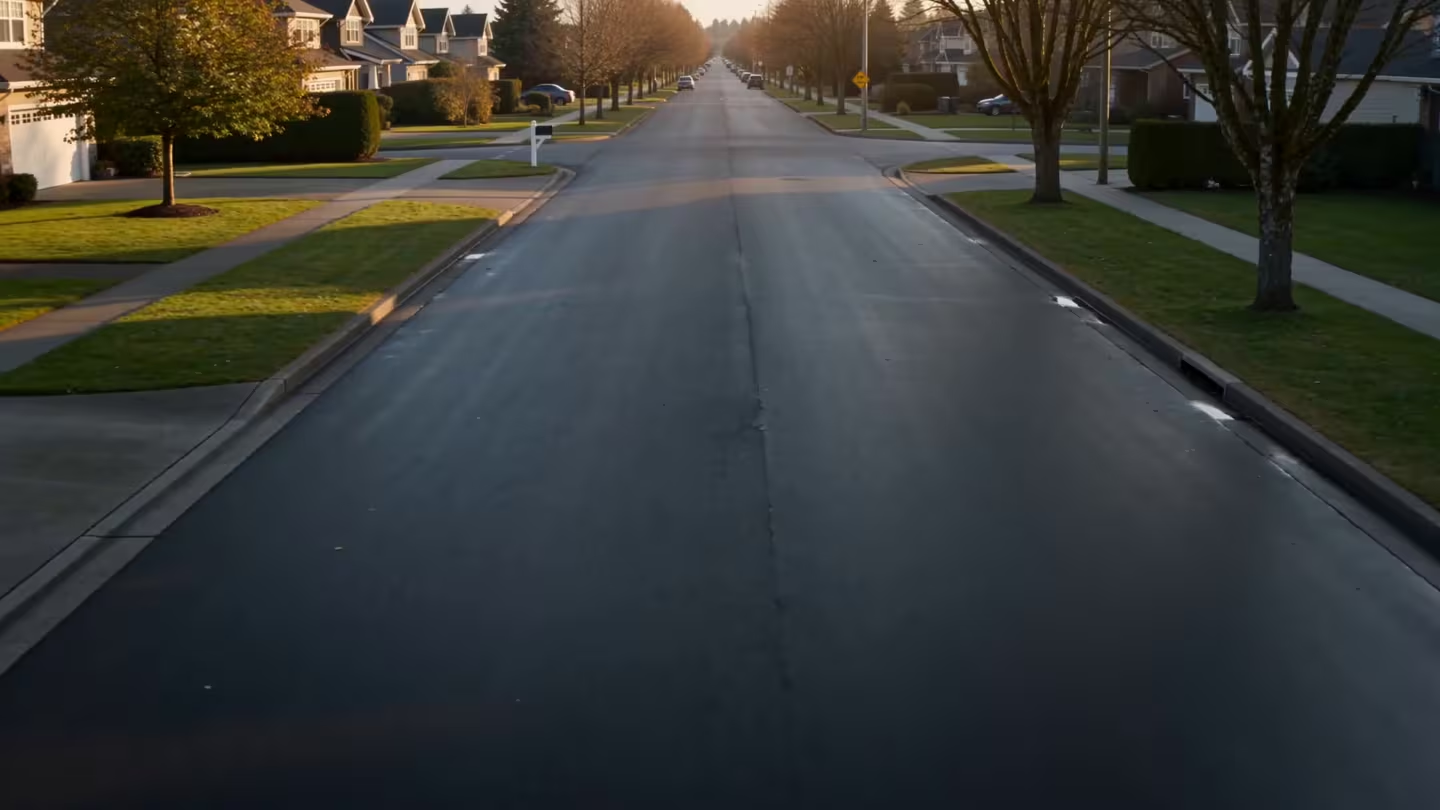
The run
Four beats through the dark.
03:12 · Beat 01 · Route
Depart
We write the origin, the destination, the access at both ends, the inventory record and every transfer point we already know — and you read all of it before the wheels move.
03:40 · Beat 02 · Vehicle
The corridor
Vehicle type, environmental options, consolidation and tracking change from move to move. We name the ones your run is planned around, so you are never left to assume them.
04:18 · Beat 03 · Conditions
The pass
Weather, grades and access can move an operating window overnight. We name who calls you when something material changes, and how quickly — before the run, not after.
05:26 · Beat 04 · Handoff
The dawn edge
The sky lightens at the far end. We put the inventory handoff in the written scope, with any placement, assembly or debris work it covers, before the doors open.
Route variables
The route is more than two addresses.
Send us the real origin, the real destination and the date. We walk the whole run through these six with you and write the answers back down, so you can read your move before you live it — planning prompts, not published lanes.
Route variable 01 · access
Origin accessDestination access
Two addresses are not a route plan. We read the stairs, the elevators, the parking, the loading area and the building's own hours at both ends, and write back what each end actually allows.
Distance reviewedWindow reviewedPlan in writing
Route variable 02 · timing
Pickup windowDelivery window
Tell us the dates you want and we write back the operating window we can plan around, with whatever it still depends on named. A requested date is an input, not a reservation.
Dates reviewedTiming documentedPlan in writing
Route variable 03 · load
InventoryVehicle plan
Move size, specialty items and access shape the vehicle and equipment plan. We build that plan from what you tell us rather than guessing it from a page.
Load reviewedEquipment reviewedPlan in writing
Route variable 04 · site rules
Building rulesCrew plan
Elevator bookings, protection rules, certificates and quiet hours shape the crew plan. Send them early and we plan the run around them, instead of meeting them on the morning.
Documents reviewedWindow reviewedPlan in writing
Route variable 05 · custody
Direct routeTransfer review
If your run involves a transfer, a consolidation or a third-party handoff, we say so in writing — plainly, before you decide. We never let a direct vehicle be assumed.
Routing reviewedTransfers disclosedPlan in writing
Route variable 06 · delivery
Inventory handoffPlacement scope
We write the far end down too: the inventory handoff, and the placement, assembly or debris work your booking covers — so the last hour is agreed long before we get there.
Record reviewedScope documentedPlan in writing
6 route variables · drag or step through
Next step
Sign the manifest for the long haul.
Tell us the route, the date and what needs care on the way. A coordinator reads it and writes back — a real person, in writing, before anything is booked.
Route, date and access · Confirmed in writing · A starting brief, not an accepted scope or booking